The story so far… I did a project with my grade 7 homeroom class based on some of the principles of Student-Centred Learning. I began by asking them, “What do you want to learn?”
So, the year (and the project) is done. This week I conferenced with students individually. I asked them to show me what they had learned, and then chatted about the process and their experience of student-driven learning. Several comments came up again and again:
1. It was fun: fun to choose what to learn, “fun to learn something I’ve wanted to learn for a while”, fun to work with other students, fun to have a bit more freedom in the classroom.
2. It was challenging: not having someone tell them what to do or what was right or wrong, and having to work that out for themselves.
3. It was too short: two weeks is not enough to really learn something well.
The students assessed their own learning, and were generally right on the money; if anything, they judged themselves too harshly. Most were quite proud of what they had accomplished in such a short space of time.
Several observations to wrap up this experiment:
1. This is an exciting approach to learning. It really motivates students to be able to direct their own learning; the students were more excited about this than many of the activities they’ve worked on during the year. It also began, even in this short time, to promote initiative: several students took quite innovative steps in their learning, and went in directions that came entirely from them.
2. It’s an eye-opening approach to teaching. It helped me reflect on my role in the learning process. Taking a step back and letting the students get on with their own learning was quite refreshing: I could then spend my time observing and commenting on their individual progress, rather than addressing the whole class. I think I had more ‘teachable moments’ in those two weeks than in any other two weeks all year.
3. It’s time-consuming. Two weeks is not nearly enough to make this a rewarding and meaningful learning experience for everyone in the class. Many students hit significant roadblocks; many changed topics partway through; some used the relaxed, non-directed nature of the classes to take, shall we say, a more relaxed approach to learning than I had hoped for. This is a project which could be extended over 10 weeks, or even a year.
Would I do it again? Yes, in a heartbeat. Here’s the plan for next year:
1. Give the students one section of the Math curriculum – for example, Measurement of Two-Dimensional figures (in grade 7, that includes using measurement in real life, devising the formulas for finding the area of parallelograms and trapezoids, and using those formulas to solve problems about area). Help them understand the language of the expectations.
2. Get them to choose (in groups of 2-3) one or two expectations. Their task then is to learn that information or skill, and then teach it to the rest of the class. How they learn it and how they teach it are up to them.
This is much more restricted than my experiment this year, but this is deliberate: I want to ease them into the freedom of student-driven learning gradually.
(this idea is taken from the blog of a Grade 6 teacher from Chicago, Josh Stumpenhorst. Check it out at http://stumpteacher.blogspot.ca/2011/03/student-driven-learning.html)
3. Spend some time early in the year helping students discover and explore their own learning styles, so they know their strengths and weaknesses as learners.
4. Discuss how to gather information (from multiple and varied sources), and how to master skills; help students see these as two separate learning activities, and discuss the differences in each approach.
5. Explore different presentation formats
6. After this initial project is done, begin a new project which will run for the whole term (10 weeks) or even the whole year. In this project, students choose what they are going to learn. It can be anything (within limits of appropriateness and feasibility). They then plan how they are going to learn it, and how they are going to show that they have learnt it.
7. Students keep a Learning Project Journal, recording the steps they are taking, including ‘failures’ and ‘mistakes’. Emphasize that mistakes are a vital part of learning!
8. Work with students to scaffold the task. Set weekly checks with each student; go over the week’s entries in the Journal.
9. Hold a Presentation Day – invite parents, administration, and anyone else the students want to come.
10. Throughout the process, create and exploit ‘meta-moments’: times when students engage in metacognition by reflecting on how they learn. Apply this thinking to other subject areas as much as possible.
11. Throughout the process, reflect and keep notes on what works and what doesn’t work so well, and refine the process for the following year.
I’m excited about this! I hope my students next year will begin to take control of their own learning in ways that I can’t even foresee.
Thanks for following my brief SCL experiment. This is my last blog on this topic, but I’d still love to hear from you about your experiences, thoughts, suggestions, criticisms, etc. You can respond to this blog (I’ll get an email alert), or connect with me in Twitter (andrewcohen67).
Happy educating.
– Andrew Cohen
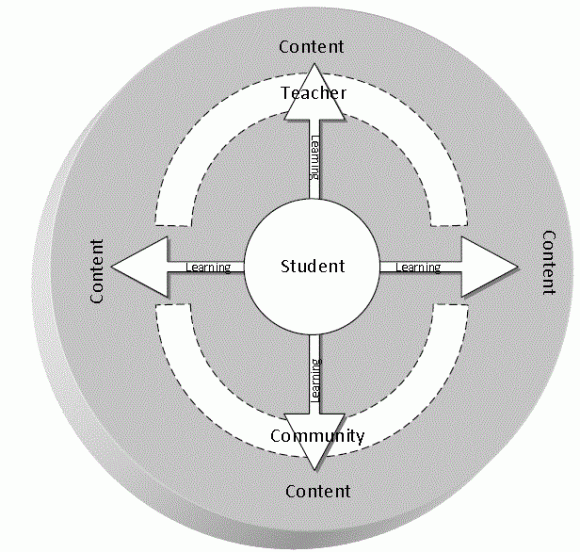


 Students at the Centre